Before You Spend This Weekend Check These 3 Money Numbers

Friday night can make money feel softer than it is.
The workweek is done. The fridge looks uninspiring. A dinner out sounds fair. So does a movie, a quick online order, a round of drinks, or a “small” treat that somehow turns into several small treats.
There is nothing wrong with enjoying the weekend. Rest matters. Fun matters. Food you did not have to cook can feel like a gift.
The problem starts when weekend spending is based on a bank balance that is not telling the full story. A checking account can look fine on Friday and feel tight by Monday once pending charges clear, automatic payments hit, and forgotten bills show up.
A five-minute money check can help you spend with less stress. You do not need a full budget. You do not need a spreadsheet. You only need three numbers.
This post is for general informational purposes only and is not financial advice. Use it as a simple planning tool and adjust it to your own situation.

Start with the number you can actually spend from
The balance your banking app shows is a starting point, not the final answer.
That number may include money that is already spoken for. Debit card transactions can take time to fully post. A bill payment may be scheduled but not yet withdrawn. A transfer may be pending. If you spend from the visible balance without adjusting for those items, you can accidentally spend money twice.
That is why the first number to check is your true available balance.
Open your bank account and look at the amount currently available. Then subtract anything that has not fully cleared yet.
Look for:
Debit card purchases that are still pending
Automatic bill payments scheduled soon
Transfers to savings, another bank, or another person
Checks that have not cleared
Payment apps that have not withdrawn from your bank yet
Buy now, pay later payments due soon
Bank holds from gas stations, hotels, or rentals
If your account says you have $620, that may feel comfortable. But if you have a $74 grocery charge pending, a $120 insurance payment scheduled, and a $50 transfer to savings already set up, your real number is lower.
Here is the math:
$620 available - $74 pending groceries - $120 insurance - $50 transfer = $376 true available balance
That $376 is the number to use for the next step, not $620.
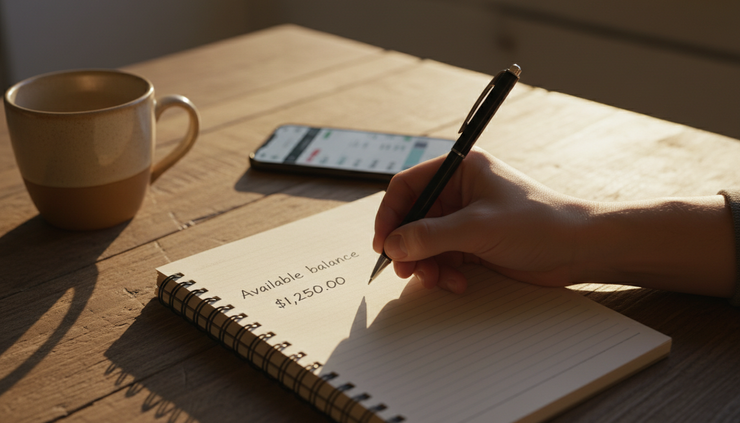
Write it down:
Available balance: $________
This one step can prevent a lot of Monday frustration. The goal is not to make the number look good. The goal is to make it honest.
Do not let pending transactions trick you
Pending transactions are easy to ignore because the money may still appear in your account. That does not mean it is safe to spend.
Some charges show up right away. Others take a day or two. Restaurants may first show the pre-tip amount, then update later. Gas stations can place temporary holds. Subscription payments sometimes hit earlier than expected, especially around weekends or holidays.
If the charge is real, treat the money as gone.
A simple rule helps:
If you already spent it, scheduled it, or promised it, subtract it before you plan the weekend.
You do not need perfect tracking. Just scan your account activity and your memory. Think through the last few days.
Did you order food on Thursday? Fill the tank? Send money through a payment app? Pay a copay? Buy something online? Schedule a transfer?
Those items count even if your balance has not caught up yet.
Check the bills due before more money comes in
Once you know your true available balance, check what has to be paid before your next payday or expected deposit.
This is the second number: upcoming bills before your next income.
Do not list every expense for the entire month. That can turn a quick check into a stressful project. For this exercise, focus only on what must happen before more money arrives.
That may include:
Rent or mortgage
Utilities
Car payment
Gas or public transportation
Insurance
Minimum credit card payments
Loan payments
Groceries
Childcare
Medical costs
Subscriptions
Automatic withdrawals
Phone or internet bill
The key phrase is “before my next income.”
If you get paid next Friday, only count the bills and must-pay expenses between now and then. If your next deposit lands on Tuesday, your list may be shorter. If your income is irregular, use the next payment you feel reasonably confident about and plan more conservatively.
Here is a simple example.
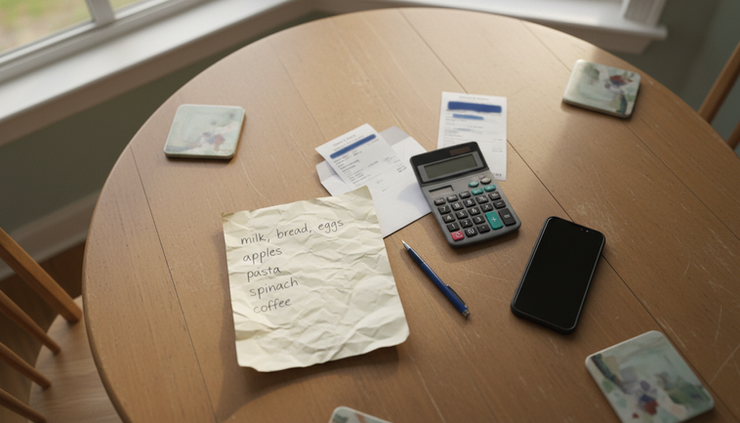
Your true available balance is $376. Before your next paycheck, you still need to cover:
Expense | Amount |
Phone bill | $65 |
Gas | $45 |
Minimum credit card payment | $40 |
Groceries | $90 |
Streaming subscription | $15 |
Total | $255 |
Write your total here:
Bills due before my next income: $________
In this example, $255 needs to be protected. It should not become dinner, drinks, delivery fees, or impulse shopping.
Include real-life needs, not only official bills
A bill is not the only thing that can drain your account.
Groceries may not be a fixed payment, but you still need food. Gas may not arrive as an invoice, but your car still needs fuel. If you commute, pay tolls, take public transportation, buy medication, or cover school expenses, those belong in this number too.
Many people underestimate weekend spending because they only subtract formal bills. Then Tuesday arrives and the money needed for basic life has already gone to fun.
This is where a small cushion helps. If you are unsure whether something will come up, leave room for it.
For example, if your grocery estimate is usually between $80 and $110, use $110. If you think gas will cost $35 but sometimes costs $50, use $50. A little overestimating can protect you from overdrafts, credit card use, or the need to move money back out of savings.
This is also a good time to scan your subscriptions. Weekly trials, delivery memberships, music apps, cloud storage, and streaming services can be easy to forget because each one may feel small. Together, they can shrink the weekend money you thought you had.
Turn what is left into a safe weekend spending limit
Now you have the first two numbers:
True available balance
Upcoming bills before your next income
Subtract the second number from the first.
Available balance - upcoming bills = remaining amount
If your true available balance is $376 and your upcoming bills total $255, your remaining amount is $121.
That does not automatically mean you can spend $121 this weekend.
The remaining amount may also need to cover small surprises, extra groceries, transportation, savings goals, or a buffer so your account does not sit too close to zero.
The third number is your weekend spending limit. This is the amount you choose to spend while still protecting the money you will need later.
Write it down:
My weekend spending limit: $________
A good weekend limit is not always the largest amount possible. A good limit is the amount you can spend and still feel okay when the weekend is over.
If $121 remains after bills, you might choose $60 for the weekend and leave $61 untouched. If money is tighter, you might choose $25. If your bills are covered and you have a healthy cushion, you might choose more.
The number should match your real life, not someone else’s.
Make the weekend limit easier to follow
A single spending limit can work, but categories make it easier to stick with.
Instead of saying, “I can spend $80 this weekend,” split the number into a few simple buckets.
For example:
Weekend category | Limit |
Food or takeout | $35 |
Entertainment | $25 |
Coffee, snacks, or small treats | $10 |
Transportation | $10 |
Total weekend limit | $80 |
Your categories may look different. You might need a birthday gift, a family activity, a date night, or gas money. The point is to decide before the money starts moving.
Try this quick worksheet:
Food or takeout: $________
Entertainment: $________
Transportation: $________
Small treats: $________
Other: $________
Total weekend spending limit: $________
This can also help you make better tradeoffs.
If dinner out costs more than expected, you may choose a free activity after. If you buy concert tickets, you may cook at home the next day. If takeout matters most this weekend, you can skip the impulse cart at the store.
You are still spending. You are just spending with a boundary.
Use a method that keeps the number visible
The best weekend limit is the one you can actually remember.
If the number only exists in your head, it may disappear after the first purchase. Make it visible somewhere you will see it before spending.
You can:
Write it in a notes app
Put it on a sticky note near your keys
Keep a running total in your phone
Move the weekend amount to a separate checking account
Use cash for flexible spending
Set a card alert for each purchase
Check your balance once on Saturday and once on Sunday
You do not need to track every penny forever. For the weekend, simple awareness is enough.
If you spend $18 on lunch and your weekend limit is $60, update the number to $42. If you spend $12 later, update it to $30. Watching the number go down helps you decide whether the next purchase is worth it.
This is especially useful for small purchases. A $7 coffee, $11 snack, $16 delivery fee, and $22 rideshare can feel separate in the moment. Together, they can drain half a weekend limit before you notice.
What to do if the math feels uncomfortable
Sometimes the three numbers tell you something you did not want to see.
Maybe your true available balance is lower than expected. Maybe upcoming bills take almost everything. Maybe there is no safe weekend spending money right now.
That can feel disappointing, especially after a long week. But finding out on Friday is much better than finding out after the money is gone.
If the number is tight, choose one of these options:
Plan a no-spend night with food you already have
Use a gift card if you have one
Invite a friend over instead of going out
Pick one treat instead of several
Look for a free local event
Delay a non-urgent purchase until after payday
Make a simple meal and save the paid activity for next weekend
You are not failing because the number is small. You are using the information early enough to protect yourself.
If your bills are at risk, prioritize essentials first. Housing, utilities, food, transportation, insurance, and required debt payments usually need attention before optional spending. If you cannot cover required bills, contact the provider as early as possible to ask about options. Waiting often makes choices more limited.

A five-minute script for your Friday money check
If you want to make this a habit, keep it simple. Use the same steps each time.
Open your bank account.
Find your current available balance.
Subtract pending purchases, scheduled payments, and transfers.
Write down your true available balance.
List bills and necessary expenses due before your next income.
Add those expenses.
Subtract upcoming bills from your true available balance.
Choose a weekend spending limit below that remaining amount.
Split the limit into categories if that helps.
10. Track the limit until the weekend ends.
Here is the short version:
Number to check | What it tells you |
True available balance | What is really in your account after pending activity |
Upcoming bills | What must be protected before your next income |
Weekend spending limit | What you can spend without creating avoidable stress |
This habit works best when it stays quick. If you only have five minutes, do the rough version. A rough check is better than no check.
The goal is a calmer Monday
Weekend spending should not feel like a mystery with consequences.
When you check these three numbers first, you give yourself a clearer choice. You can still order dinner, go out, buy the treat, or plan something fun. You can also decide to keep it simple because the numbers show that future you needs the money more.
Either way, the decision is yours.
Before you spend this weekend, check these 3 money numbers: your true available balance, your upcoming bills, and your weekend spending limit. Write them down. Pick a number that protects the week ahead. Then enjoy the weekend inside a boundary you chose on purpose.


Comments